Challengers Crease · 2026
Turning Net-Session Practice Into a Global Ranking Game

Turning Net-Session Practice Into a Global Ranking Game

Turning Net-Session Practice Into a Global Ranking Game

Challengers Crease is a cricket performance app that scores your batting and bowling with AI, then turns that score into live 1v1 battles, leagues, and a global leaderboard. I designed the end-to-end mobile experience — from onboarding to the scoring engine's visual language.

Challengers Crease is a cricket performance app that scores your batting and bowling with AI, then turns that score into live 1v1 battles, leagues, and a global leaderboard. I designed the end-to-end mobile experience — from onboarding to the scoring engine’s visual language.

Role

Lead UI/UX Designer

Timeline

12 weeks, 2026

Team

1 Designer, 2 Engineers, 1 PM

Platform

iOS & Android

02 — Problem

A scoring engine with no face

A scoring engine with no face

A scoring engine with no face

The product had a real technical backbone before it had a UI: an AI vision pipeline scoring individual deliveries, a discipline-specific ELO-style rating engine — batting and bowling tracked separately, with K-factor bands that change as a player logs more matches — and a bot-matchmaking layer designed to solve cold-start, making sure a brand-new player always has someone their own level to challenge, even on day one with zero real users online.

The product had a real technical backbone before it had a UI: an AI vision pipeline scoring individual deliveries, a discipline-specific ELO-style rating engine — batting and bowling tracked separately, with K-factor bands that change as a player logs more matches — and a bot-matchmaking layer designed to solve cold-start, making sure a brand-new player always has someone their own level to challenge, even on day one with zero real users online.

None of that means anything to a player if it isn't legible in three seconds on a phone screen. The challenge wasn't proving the AI worked — it was translating a dense backend (percentile-based seed ratings, exponential-decay consistency scores, five-axis skill radars, wagon-wheel zone entropy) into something that felt like a sports app, not a spreadsheet.

None of that means anything to a player if it isn’t legible in three seconds on a phone screen. The challenge wasn’t proving the AI worked — it was translating a dense backend (percentile-based seed ratings, exponential-decay consistency scores, five-axis skill radars, wagon-wheel zone entropy) into something that felt like a sports app, not a spreadsheet.

01

Invisible confidence

A raw 0–100 rating means nothing without context — tier, benchmark, and opponent framing are what make a score feel real.

02

A cold-start problem

No live opponents on day one. Matchmaking had to feel populated and fair immediately — bots needed to be indistinguishable from real players.

03

Three doors, one mental model

Challenge a Friend, Global Match, and Leagues all needed to feel like variations of the same core loop — not three separate apps stitched together.

03 — Research

Reading the system before designing the screen

Reading the system before designing the screen

Reading the system before designing the screen

Rather than user interviews — the product didn't exist yet in market — the research phase was a deep audit of the product's own technical specs: the rating system doc, the AI scoring service, the bot logic brief, and a written challenge-flow spec from the product team. I mapped every formula, threshold, and edge case to a UI decision before opening Figma.

Rather than user interviews — the product didn’t exist yet in market — the research phase was a deep audit of the product’s own technical specs: the rating system doc, the AI scoring service, the bot logic brief, and a written challenge-flow spec from the product team. I mapped every formula, threshold, and edge case to a UI decision before opening Figma.

From — Player Rating System doc

10 discrete tiers (Rookie → Maestro across 0–100), discipline split — Batting PR and Bowling PR tracked independently, All-Round derived from a 70/30 weighted blend.

→

Tiers became a visible progress ladder, not just a number. Players always know what's next.

From — Bot Logic doc

Bots span the full skill spectrum and are indistinguishable from real users in the UI — no bot badge, no tell, consistent opponent card treatment.

→

One opponent card design: avatar, name, location, rating. The same every time, real or bot.

From — Metric Snapshot Service doc

Five-axis skill radars per discipline, wagon-wheel shot-zone map, pitch-map delivery chart — all derived from the AI scoring output.

→

The radar became the app's signature data viz — reused across assessment, challenges, and stats. Learn it once, trust it everywhere.

K-factor band table

matches_played

k_factor

0–9

32

10–29

24

30+

16

→

→

→

Tier progress bar

Contender · 62 PR

Expert at 70

R

A

C

E

E

M

M

Each tier threshold is derived from the K-factor band — higher K = steeper early climb.

Each tier threshold is derived from the K-factor band — higher K = steeper early climb.

04 — Ideation

One core loop, three doors in

One core loop, three doors in

One core loop, three doors in

Every competitive mode in the app — 1v1 friend challenges, global matchmaking, and multi-week leagues — funnels through the exact same underlying loop: pick a challenge → see scoring criteria and how-to-play → record up to 6 deliveries → get an AI-scored skill radar → compare against a benchmark → decide who to challenge next. Once that loop was solid, designing three entry points became a question of framing, not new interaction patterns.

Every competitive mode in the app — 1v1 friend challenges, global matchmaking, and multi-week leagues — funnels through the exact same underlying loop: pick a challenge → see scoring criteria and how-to-play → record up to 6 deliveries → get an AI-scored skill radar → compare against a benchmark → decide who to challenge next. Once that loop was solid, designing three entry points became a question of framing, not new interaction patterns.

Challenge a Friend

Global Match

Leagues

Pick challenge

→

→

How-to-play

→

→

Record 6 balls

→

→

AI scores radar

→

→

Compare

→

→

Challenge next

← The shared core loop →

The shared core loop

"The scoring screen had to do the same job whether you'd just done your very first assessment or your 200th league match — celebrate the number, then immediately make the player want to challenge someone."

“The scoring screen had to do the same job whether you’d just done your very first assessment or your 200th league match — celebrate the number, then immediately make the player want to challenge someone.”

Design principle — scoring screen

Onboarding: engineering a dopamine beat before the paywall

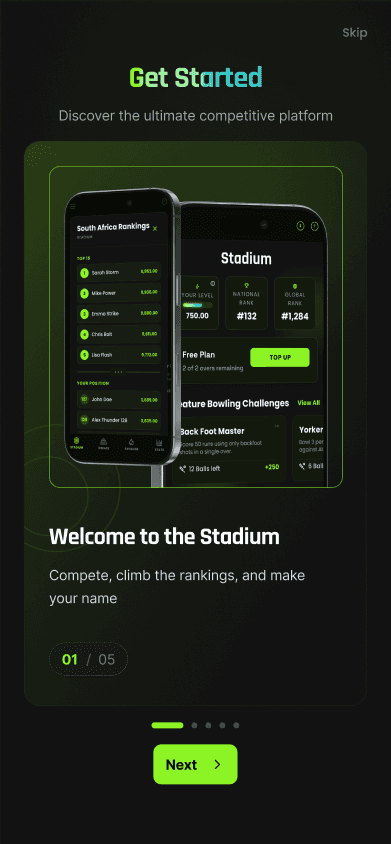
The onboarding was deliberately sequenced: Get Started carousel → phone/OTP auth → identity capture (name, batting and bowling hand, favourite player) → photo → profile summary → "Profile Created" moment. Every step reduces friction and increases investment. The "Profile Created" reveal — staged as its own full-screen beat — was designed to be the player's first win, before any paywall appeared.

The onboarding was deliberately sequenced: Get Started carousel → phone/OTP auth → identity capture (name, batting and bowling hand, favourite player) → photo → profile summary → “Profile Created” moment. Every step reduces friction and increases investment. The “Profile Created” reveal — staged as its own full-screen beat — was designed to be the player’s first win, before any paywall appeared.

05 — Designs

The experience, screen by screen

The experience, screen by screen

The experience, screen by screen

5.1

Onboarding & Identity

A five-step, low-friction setup — phone verification, playing identity, and a favourite-player pick — ending on a 'Profile Created' moment before any paywall appears.

A five-step, low-friction setup — phone verification, playing identity, and a favourite-player pick — ending on a ‘Profile Created’ moment before any paywall appears.

5.2

Initial Assessment

Every player's first six balls. This single flow converts a stranger into a ranked player. Base Rating reveal, then country and global rank, each staged as its own pop-up beat — not dumped on one screen.

Every player’s first six balls. This single flow converts a stranger into a ranked player. Base Rating reveal, then country and global rank, each staged as its own pop-up beat — not dumped on one screen.

5.3

1v1: Challenge a Friend & Global Match

1v1: Challenge a Friend & Global Match

Two entry points, one shared recording-and-scoring flow. Friend challenges lean social — contact picker, 72-hour accept window. Global Match leans competitive — ELO-proximity matching, no names needed until a result exists.

Two entry points, one shared recording-and-scoring flow. Friend challenges lean social — contact picker, 72-hour accept window. Global Match leans competitive — ELO-proximity matching, no names needed until a result exists.

5.4

Leagues

Multi-week structured competition — a visible schedule, week-by-week challenge unlocks, and a cumulative leaderboard that updates live. Climbing a league always feels like a running story, not an isolated score.

Multi-week structured competition — a visible schedule, week-by-week challenge unlocks, and a cumulative leaderboard that updates live. Climbing a league always feels like a running story, not an isolated score.

5.5

Fan Zone

Between matches, engagement doesn't stop. Round-based cricket knowledge quizzes and live prediction polls both feed the same global leaderboard as on-pitch performance — competitive even off the field.

Between matches, engagement doesn’t stop. Round-based cricket knowledge quizzes and live prediction polls both feed the same global leaderboard as on-pitch performance — competitive even off the field.

5.6

My Stats

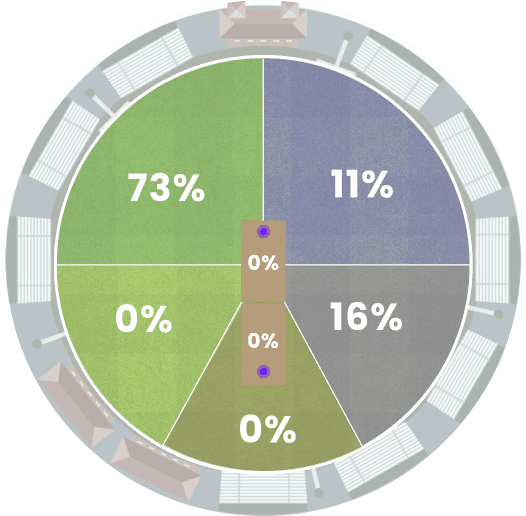
The single screen every other flow feeds into. Batting and bowling toggle between two purpose-built visualizations — a skill radar and a wagon wheel for batting, a skill radar and a pitch map for bowling — built directly off the AI scoring service's five-axis output.

The single screen every other flow feeds into. Batting and bowling toggle between two purpose-built visualizations — a skill radar and a wagon wheel for batting, a skill radar and a pitch map for bowling — built directly off the AI scoring service’s five-axis output.

06 — System

A system built for legibility under pressure

A system built for legibility under pressure

A system built for legibility under pressure

Because every screen centers on a live score or a live opponent, the UI needed to stay legible in a locker room, mid-net-session, one-handed. Dark backgrounds cut glare, one signature accent color marks anything actionable or "you," and the skill radar shape recurs everywhere so players never have to re-learn how to read their own performance.

Because every screen centers on a live score or a live opponent, the UI needed to stay legible in a locker room, mid-net-session, one-handed. Dark backgrounds cut glare, one signature accent color marks anything actionable or “you,” and the skill radar shape recurs everywhere so players never have to re-learn how to read their own performance.

Color

Base

#0A0F0A

Accent

#8BFF00

Secondary bg

#0F1A0F

Muted text

#666E66

Case study bg

#141414

Data Viz

5-axis radar (shared)

Wagon wheel
Components

Primary CTA

Secondary

Batting

Bowling

All-Round

Stadium

Crease

Fanzone

Stats

07 — Lessons

What this project taught me about designing on top of a live scoring engine

What this project taught me about designing on top of a live scoring engine

What this project taught me about designing on top of a live scoring engine

01

Trust has to be designed

Designing UI for an AI-scored product means the interface's main job is building trust in a number the player can't see the math behind. Benchmarks, tier comparisons, and opponent context matter more than the raw score itself — the number alone means nothing.

Designing UI for an AI-scored product means the interface's main job is building trust in a number the player can't see the math behind. Benchmarks, tier comparisons, and opponent context matter more than the raw score itself — the number alone means nothing.

02

Reuse is coherence

Reusing one visual language — the skill radar — across assessment, 1v1 results, league stages, and the stats tab did more for perceived product coherence than any individual screen's polish. Players learn to read it once and it pays dividends everywhere.

Reusing one visual language — the skill radar — across assessment, 1v1 results, league stages, and the stats tab did more for perceived product coherence than any individual screen's polish. Players learn to read it once and it pays dividends everywhere.

03

Cold-start is a UI problem

Solving for a cold-start problem where bots are indistinguishable from real players is a UI decision as much as a backend one. One inconsistent visual treatment — a bot badge, a different card layout — would have broken the illusion instantly.

Solving for a cold-start problem where bots are indistinguishable from real players is a UI decision as much as a backend one. One inconsistent visual treatment — a bot badge, a different card layout — would have broken the illusion instantly.